

What Is Proof of Action? The 6 Formats Explained (2026)
Proof of action is durable evidence that you did what you said you would do. The definition, why it beats a checkbox, the six proof formats Aksa uses, and what each one actually shows.
Published October 2, 2026 · Updated October 22, 2026 · 7 min read
Proof of action, defined
Proof of action is durable evidence that a person completed a specific action. It can be a photo, a written answer, a count, a timed session or a confirmation - the point is that someone other than your own memory can check it.
Two words in the definition do the heavy lifting. Durable: the evidence persists and stays reviewable, attached to the record. Checkable: another person - or future you - could inspect it and reach the same conclusion.
Without proof, a goal tracker records intent. With proof, it records what happened. That is the entire difference between a diary of plans and a record of work.
Why proof matters more than a checkbox
A checkbox tells you that someone tapped a box. It does not tell you whether the work happened - and over weeks, honest tapping predictably degrades into streak-protecting tapping, producing a record even its owner does not believe.
Aksa treats this gap as the core problem: progress, streaks and the weekly podium count only verified proof, never an unverified tap or an AI claim. The record's currency is evidence, so the record cannot be inflated by enthusiasm.
Proof also gives other people something real to respond to. A photo of finished work or a written reflection invites support; a ticked item invites nothing. Aksa reports a 36% social response rate (company-reported) - reactions need material, and proof is the material.
The checkbox also fails socially: nobody can react to a tap with anything real to say. 'Nice tap' is not a message anyone sends. But 'that trail photo - where is that?' starts a conversation, and conversation is the glue that keeps a room - and its members' streaks - alive.
The six proof formats in Aksa
Aksa maps every daily action to one of six formats. Photo: a live camera shot or gallery upload for visible results - the finished page, the cooked meal, the workspace. Answer: a short written response for thinking work - the chapter summary, the decision and its reason.
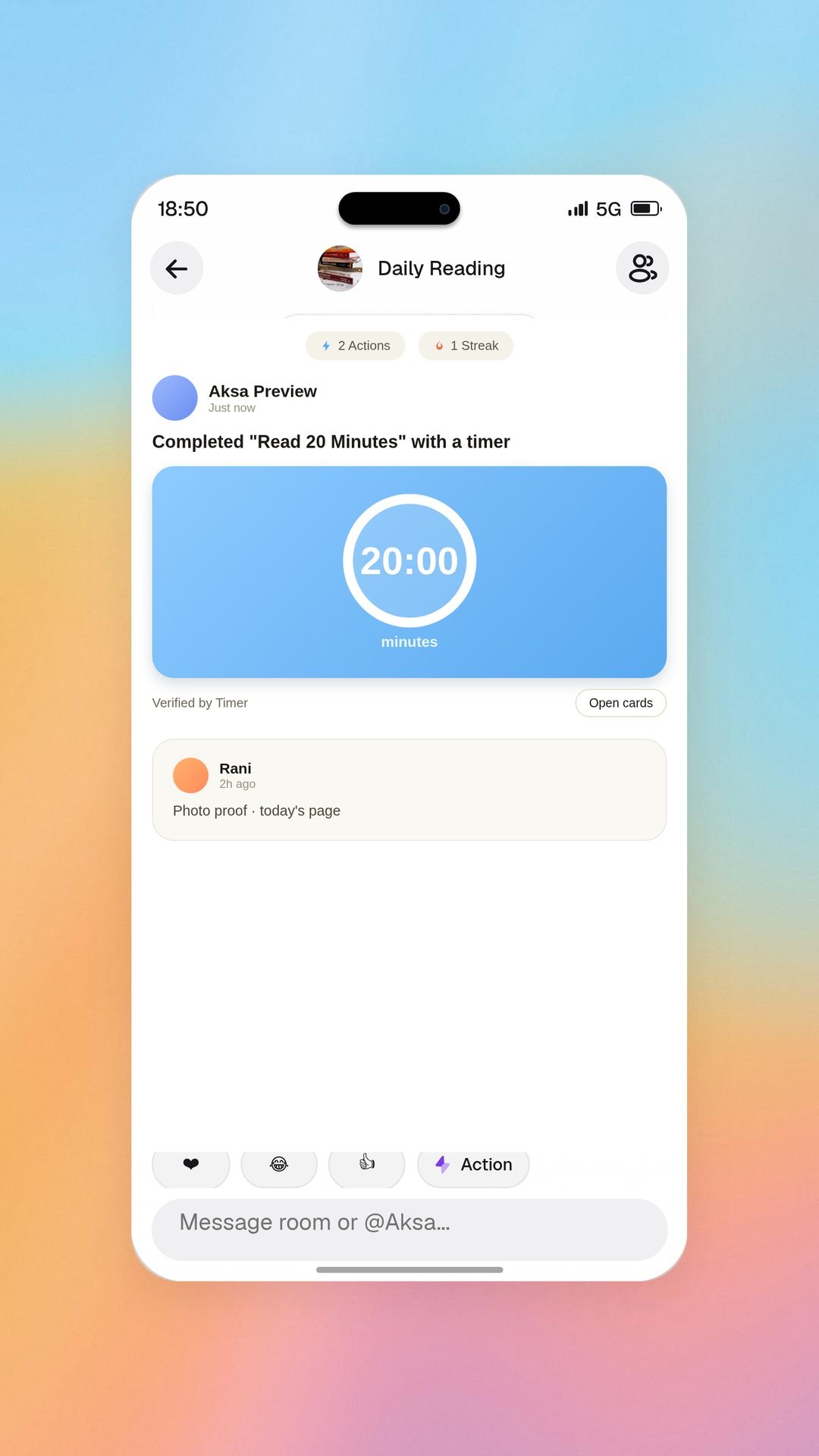
Counter: a tally against a target for repetitions - 50 push-ups, 8 glasses of water. Timer: a countdown or stopwatch session for bounded focus - the 25-minute study block, with a confirm step on early finishes.
Check-in: presence without location tracking - arrived at the gym, made the lecture. Confirm: a yes-or-no for binary days - habit kept or avoidance held, with a peer-confirmation option where a partner attests.
What each format actually shows
Every format has a strength and a limit, and honest labeling is what keeps the whole record trustworthy. A live photo strongly suggests the artifact existed at that moment; a gallery upload is weaker and says so. Neither proves the work was good - only that the result was there.
Hand-entered counts are labeled unverified - your word, on the record. Device-read totals (steps from Apple Health or Health Connect, arriving with the 1.2 update behind a flag) are labeled device-reported, and Aksa states plainly they are never tamper-proof.
The principle running through all six: Aksa never upgrades weak or missing evidence into verified proof. The label travels with the proof forever, so anyone reading the record - including you in a year - knows exactly what each day was made of.
Choosing the right proof for your action
Work backward from the action's shape - what exists when it is done?
- Visible result exists - Photo, live capture for strength.
- Work happened in your head - Answer, concrete and short.
- Day reduces to a number - Counter, target set in advance.
- Work is time-in-seat - Timer, plus an answer after.
- Task is showing up - Check-in, no location trail.
- Day is binary - Confirm, peer confirmation for stakes.
- Proof takes over a minute - Too heavy; pick a lighter format.
Proof and the social layer
Proof is what makes the social features meaningful instead of noisy. A room feed full of photos, answers and timer sessions is a feed of work; the same feed full of 'done!' taps would be a feed of claims. The difference is whether reactions attach to reality.
The surfaces all run on proof: the member heatmap fills from proof-backed days, the weekly leaderboard ranks verified work, and the podium's winner spotlight cards represent weeks that actually happened.
This is also why comparison stays fair: when everyone in the room submits the same proof format against the same standard, the leaderboard measures work - not who is most generous with their own checkbox.
A worked example: one week, five formats
Monday: morning run - photo of the watch display, live capture. Tuesday: study chapter - timer session, 25 minutes, plus a two-sentence answer. Wednesday: push-up sets - counter, 50, hand-counted and labeled unverified.
Thursday: the lecture - check-in on arrival. Friday: the avoidance rule - confirm, 'no sugar,' with a one-line note because the office had cake. Five days, five proofs, each chosen for the shape of the work.
Sunday's review reads the week in seconds because every day is inspectable: the heatmap full, the formats honest, the one hard day documented instead of hidden. That is what 'proof of action' buys - a week you could show a skeptic.
Proof of action vs proof of progress vs proof of identity
The three levels are worth separating. Proof of action: the run happened Tuesday - one day, one artifact. Proof of progress: the weekly reviews show pace improving - many days, read as a trend. Proof of identity: six months of the record say 'I am a runner' - the accumulated evidence that changes what you attempt next.
Most tracking debates obsess over the first level - was Tuesday real? - when the payoff lives at the second and third. A single proof is a fact; the chain of proofs is a trajectory; the trajectory is what lets you set bigger targets with justification instead of hope.
This is why durability and labels matter so much at the bottom level: trends and identities built on shaky Tuesdays are fiction with charts. Get the daily evidence right, cheaply, forever - the higher levels take care of themselves.
The payoff: a record that compounds
Days of proof accumulate into something larger than any single artifact: a track record. Weeks of it calibrate your planning - you learn your real capacity instead of your imagined one. Months of it become portable credibility - a room, a partner or a coach can see the pattern, not the pitch.
The compounding is why the cheapness rule matters so much: the record only builds if the daily cost stays near zero. Thirty seconds of proof per action is the budget that keeps a year-long chain possible.
And the compounding is why the honesty rules matter: one inflated day quietly devalues every day around it. A record that admits its limits is the only kind worth keeping - and the only kind worth showing.
FAQ
What is proof of action?
Durable evidence that a person completed a specific action - a photo, written answer, count, timed session or confirmation that someone other than your own memory can check. Without proof, a tracker records intent; with proof, it records what happened.
Why is proof better than a checkbox?
A checkbox records a tap; proof records the world. Checkbox streaks degrade into streak-protecting taps that even the owner disbelieves. Aksa counts only verified proof toward progress, streaks and the weekly podium - never an unverified tap or an AI claim.
What are the six proof formats?
Photo (live camera or gallery) for visible results; Answer (short written response) for thinking work; Counter for repetitions against a target; Timer (countdown or stopwatch) for focus blocks; Check-in for presence without location tracking; Confirm for binary days, including peer confirmation. Every daily action maps to exactly one of them - the mapping forces the action to be concrete before the first day starts.
Is proof of action the same as verification?
Proof is the evidence; verification is the rule that checks it. Verified Done - Aksa's completion state - requires both: durable proof submitted and the action's verification rule met. Proof without a rule is just a file; the rule is what makes the evidence count.
Can proof of action be faked?
Any consumer proof can be gamed, so Aksa labels strength instead of pretending: live photo vs gallery upload, unverified hand counts, device-reported (never tamper-proof) totals, self vs peer confirmations. Weak evidence is never upgraded into verified proof - the labels keep the record honest.
What is the easiest proof format to maintain daily?
Whichever fits the action in under thirty seconds: a live photo for visible work, a two-sentence answer for thinking, a counter tap for reps. Cheapness is a design requirement - the record only compounds if the daily cost stays near zero.
How does proof work for goals with no visible output?
Thinking work gets a written answer; time-in-seat gets a timer session; avoidance gets a confirmation; presence gets a check-in. Every goal shape has a format - the mismatch to avoid is photographing an absence or confirming a quantity.
Why does proof matter socially?
Reactions need material: a photo of finished work or a real reflection invites support; a ticked box invites nothing. Proof-backed feeds, heatmaps and leaderboards keep rooms about work rather than claims.